



Sabatti Rover 870 De Luxe 7x64 revival
The Sabatti 870 De Luxe, chambered in the 7x64 cartridge, is an old school rifle, made when the world had still guns made of steel and wood, rather than aluminum alloy and polymer.

Sabatti Rover 870 De Luxe 7x64 revival
Sometimes life has nice things kept aside just for you, things you didn’t even know you wanted, if not theoretically… like a deer rifle, when you don’t even hunt deer.
Indeed, while not a hunter myself, I always admired well made, high end hunting rifles: where target rifles and military rifles are driven by sheer utilitarianism and function, since the times of the first wheel lock firearms the hunting rifle has always been the place where art meets technology, the result of the efforts of the best gunsmiths, engravers and stock makers, a status symbol as well as a ballistic instrument, and this is still true as of today, with high end hunting rifles showcasing the best skills in gun making. Unfortunately, I’m not that wealthy: I’ve always been limited to admiring such rifles at gun shows, in gun shops and in magazines, and I thought I’d never be able to own one.
Never say never.


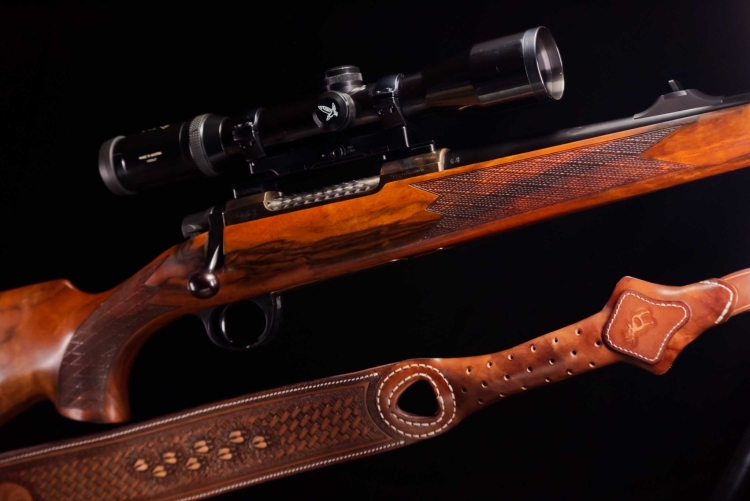
Left view of the rifle with the scope and the worked leather sling
I found this Sabatti Rover 870 De Luxe in a large stock of guns set out to be sold at a very affordable outlet price.
It was mixed with a bunch of F-Class models, polymer stocked utilitarian hunting rifles and tactical looking long-range carbines and, while it is not a Fanzoj or Fuchs, or a high end Mauser, it still stood out as a thing of beauty, like a peacock in a henhouse.
I use the term “peacock” with good reason: the receiver and magazine floorplate of the rifle are finished with a very nice case-hardened finish, with vibrant, contrasting colors so hard to find nowadays on run of the mill guns, usually showing washed out case hardenings not even remotely comparable to what you would expect on a case-hardened receiver.
The barrel’s blueing is deep, rich, polished: a stark contrast to the sandblasted matte black found on most current rifles.
The jeweled bolt is another detail from times gone by: it’s a rare thing to see such a finish on production rifles anymore, it’s only found on custom jobs.
I would have liked the trigger guard and bolt tail to be case-hardened steel as well, instead the former is made of black anodized alloy, while the latter is matte black, as it is produced by investment casting, which doesn’t take a nice blueing, but it’s a small thing and, well, gift horses and all that stuff.

The wooden stock is the perfect complement to such beauty: made of well-figured walnut, it is finished with a nice, silk-smooth oil finish.
As the jeweled bolt, the hand-made interrupted checkering seen on both the grip and handguard is usually seen only on fine custom rifles, not production line guns.
And yes, this Sabatti Rover 870 De Luxe, while being on the high end of the production line, was still a production rifle, not a custom job.
According to the manufacturer’s archives, the gun was made in 2009-2010, so not that many years ago (ok… it’s 15 years ago, yes, many years ago even if I’d like to think of the 2010 as 5 years ago) but the fit and finish are something calling back to the ‘80s.

The beautifully case hardened magazine plate
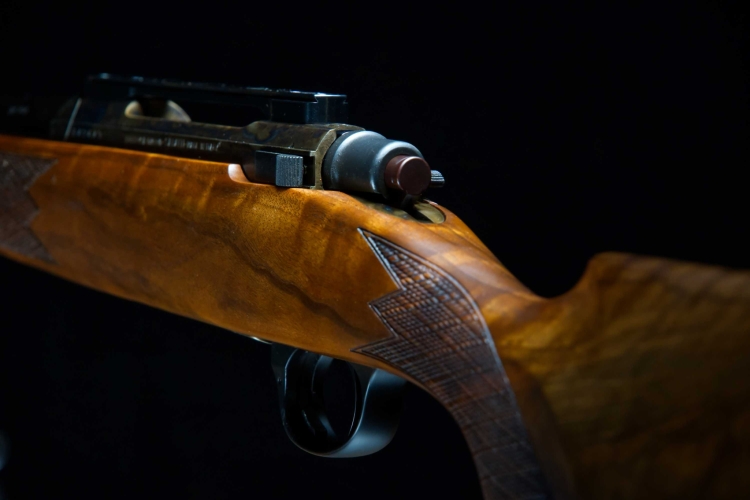
The action is the Sabatti Rover 2-lugs

The case hardened receiver and jeweled bolt body. They don't make them like this anymore...
The action is the classic Sabatti two-lug action, recently pulled from production to be replaced with a three-lug bolt. I really don’t get it.
I mean, yes, I can understand a wish to modernize the production line, I know how a three-lug bolt with full diameter body is cheaper to manufacture than a traditional two-lug bolt that requires extensive lathe time to be turned down, and the supposed “faster” action of three-lug bolts and how they are easier to operate with a scope on the gun… but the Sabatti two-lug bolt action is very, very good and, above all, butter smooth and lightning fast (you can’t say the same of the newest three-lug action on the current line of Rover Sabatti rifles, which is stiff and suffers from a marked two-time bolt opening that makes it slow and disagreeable to actuate). The older Sabatti two-lug action still has many estimators, and it’s a pity that it has been pulled from production altogether: it would be perfect on a classic line of higher end guns, and Sabatti knows how to make them, as this one clearly showcases.
The rifle is chambered for the 7x64 mm (also called 7x64 Brenneke) cartridge: a classic among classics in European hunting cartridges, together with the 6.5x55 SE, due to its versatility and accuracy.
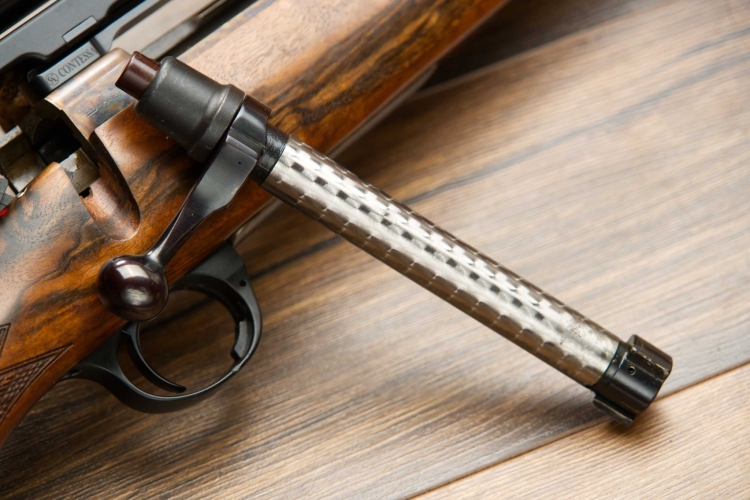
The two lug bolt

The beautifully figured walnut stock with recoil pad
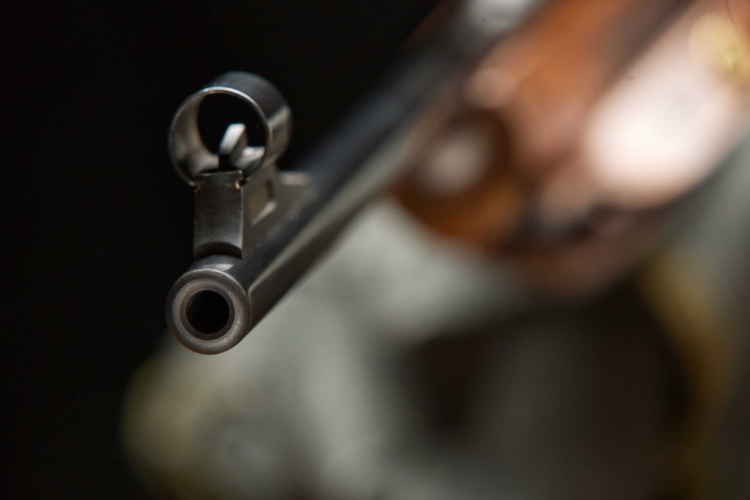
The rifle has iron sights. The barrel is the classic pencil hunting barrel, but it is very accurate
Well, long story short, given the very affordable price tag, I instantly bought the rifle, not because I had any plans to hunt deer, or because I had any specific practical use in mind for it: just because.
What I really wanted was to build my own ideal ‘80s fine deer rifle: the materialization of my memories of the many hunting rifles I had admired so many times as a kid, and this Sabatti 870 De Luxe was perfect: though born in the ’10 of the XXI century, it still had the immortal lines and finish of a classic rifle of the times of yonder.
Modern scopes, with their anodized aluminum tubes and exposed “tactical” turrets were banned, as well as modern polygonal, anodized aluminum scope rings: they would clash like a hooker at a wedding with the beautiful hard-casing, the jeweled bolt and gorgeous oil-polished walnut.
I needed something different: I needed something classic.
Or, at least, classical looking.

For the scope, I wanted a hunting scope with a blued steel tube, capped turrets and a classic hunting reticle.
I feared it would be a real pain to source, instead it came about far more easily than I had feared thanks to Giacomo, of Armeria Casabella in Casatenovo, who found me exactly what I needed: a Swarovski Habicht 1.5-6x42 with a nice polished and blued steel tube and a classic German #4 reticle: perfect!
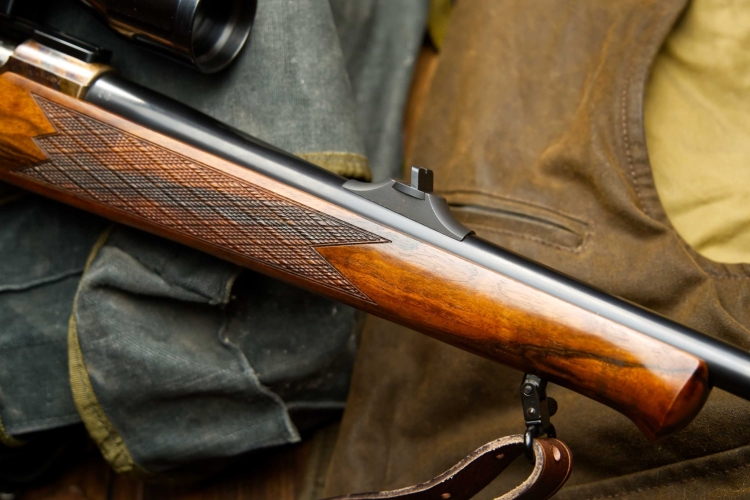
The handguard features a beautiful skip line (or "Scottish") checkering...
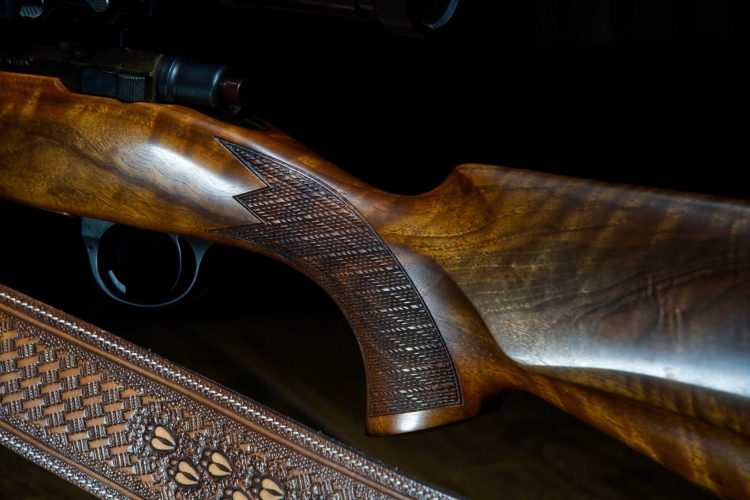
... and so does the pistol grip. The wood grain is very beautiful
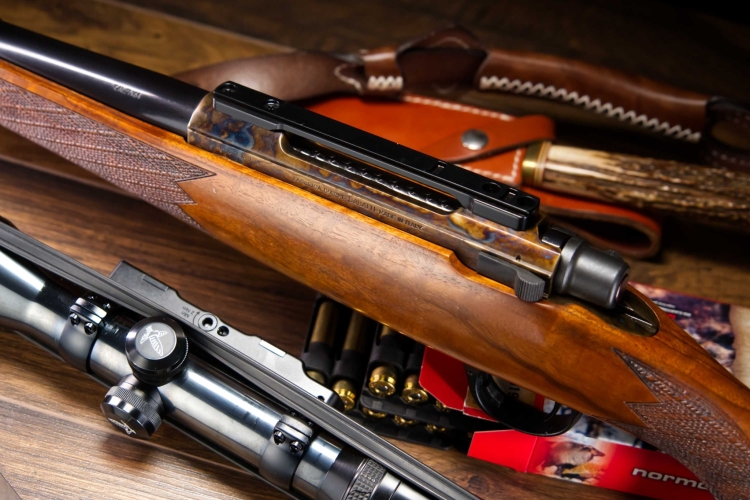
The rifle with Contessa rail mounted on the receiver and the scope on its quick detach mount
The rings were another matter entirely. I hoped to find something second hand, but I didn’t know how they would fit the 870 receiver screw holes: they are supposed to be Remington 700 compatible, but Sabatti often changes specs without warning, and I didn’t want to spend a lot of money only to find out mounting holes didn’t match.
I found new rings, round, blued, almost like I wanted them, but the price tag was shocking, as they would cost me almost as much as what I had paid for the rifle.
But where there’s a will, there’s a way: I talked about my project with Alessandro Contessa of Contessa scope mounts, and he was glad to help me out. He provided me with one of his round rings QD mounts and rail, that gave me not only a classic looking scope mount, but QD capability as well while maintaining a classic enough look, with a price tag I could actually afford (Contessa mounts are not only of the highest quality: they are also reasonably priced for top tier scope mounts).
Even more, Alessandro told me to bring the gun to Contessa, and the rail was hand fitted to the receiver for perfect coupling and alignment (plus, a perfectly fitted rail won’t mar the finish of the receiver).
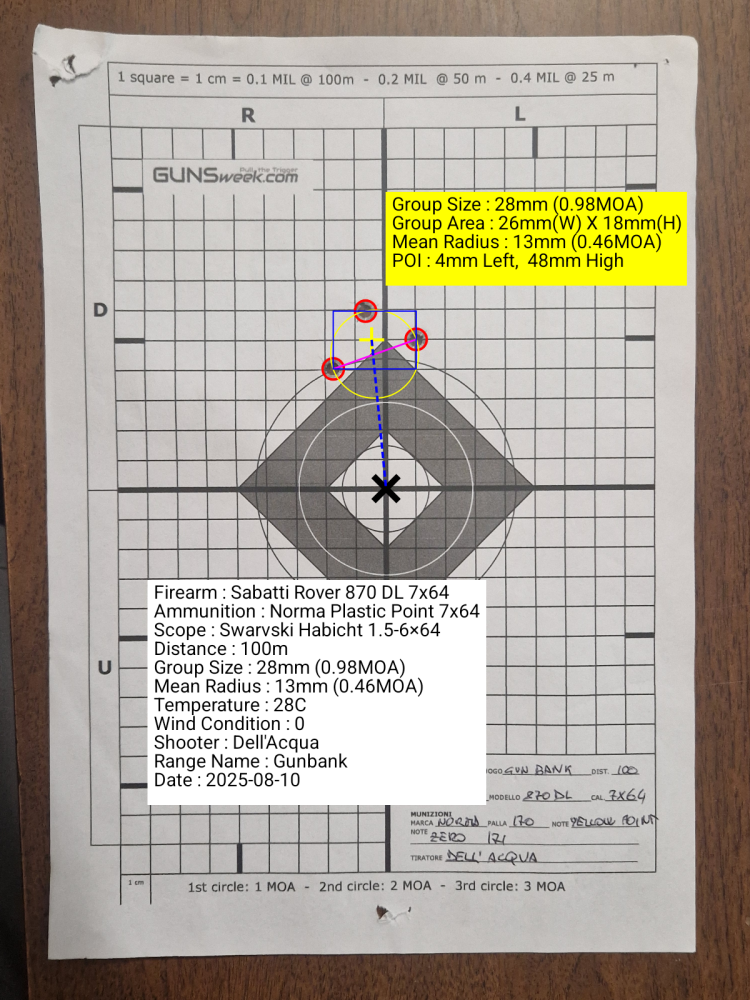
100 meters target with Norma ammunition. The shot are high since the rifle was zeroed at 100 meters for a 171 m Point Blank Range
Having dealt with scope and rings, I only needed a sling.
A brief search online brought me to a sling that was exactly what I was looking for: all leather, with a very Mitteleuropean style.
Given the theoretical purpose of the rifle, I mounted it Rhodesian style (or, if you like, more in line with the style of rifle, “Jaeger style”), with a half twist to make it perfect for steadying the rifle in offhand shots.
Coarse zeroing was done with an optical collimator, then I brought the rifle to the range. The actual zeroing was done at 100 meters with the offset method, to zero the gun for maximum Point-Blank Range (PBR), or GEE (günstigste Einschussentfernung) “best shooting distance” in German.
This method consists in zeroing at the distance that offers the longest range where the Point Of Impact (POI) is within 4 cm of the Point Of Aim (POA).
According to GECO ballistic data, GEE for 7x64 with the 170 grains load I have is 171 m, offering a PBR of about 200 m. Looking at the ballistic chart on the box, it means that at 100m the POI should be 4 cm higher than POA. This way you can zero for 171m on a 100m shooting line.
The Geco Soft Point 170 grainers did good enough, with a 1.37 MOA group at 100 meters, which isn’t bad at all for an affordable hunting load.

The Norma Plastic Tip 170 grain cartridges hit the target one cm above that, and showed a slightly sub-MOA group, at 0.98, that fully represents the ballistic capabilities of the caliber and the gun.
I didn’t perform my usual 3-shot, 3-groups test because it would have been pointless: this is no target rifle, it’s a pencil-barreled hunting rifle with a 3-shot magazine, and that is all the gun is expected to shoot consecutively, if at all.
After 3 7x64 shots, the barrel gets HOT, and while Sabatti barrels are stress relieved and built to withstand heating better than the vast majority of other manufacturers’ tubes, they still must follow the rules of physics: steel dilates and accuracy decays. Plus, there’s really no reason to overheat a fine barrel to prove a point that will never be put into practice.
The Sabatti 870 De Luxe in 7x64 with its Swarovski Habicht scope and steel rings is not just an accurate hunting rifle: it is a good example of how you can make a very fine production gun that satisfies the classic requisites for a high-end rifle.
So now I have my fine deer hunting rifle I always dreamed of as a kid, though I’ll never hunt deer.
Or will I? Who knows…
Never say never.