
Colt "Cap and Ball" revolvers calibers: why .36 e .44?
Have you ever wondered why the Colt "Cap and Ball" percussion revolvers were chambered for weird calibers like .28, .36 and .44 instead of even numbers like .30, .40 or .50?

Two Uberti replicas of two iconic american cap-and-ball revolvers: the .36 caliber Colt 1851 Navy and the .44 caliber Colt 1860 Army (Military leather holster reproduction by Triple K)
The Colt Paterson, the first cap-and-ball revolver Samuel Colt produced, in 1836, was originally chambered in an odd caliber: .28, measured in hundredths of an inch.
The production of the Colt Paterson then switched to .36 caliber. That caliber stayed in use on many later Colt cap-and-ball revolvers, alongside other models chambered in .44.
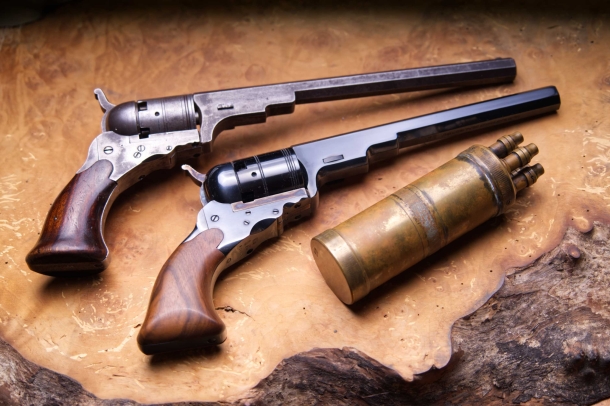
An original Colt Paterson 1836 and a 20 years old Uberti replica (both Uberti collection)
Anyone familiar with 19th-century American cap-and-ball revolvers, whether Colt or Remington, has become accustomed to .36 and .44 as the traditional standard calibers for this kind of gun. But give it a moment's thought: isn't it odd that a manufacturer would pick such peculiar, almost "weird" numbers instead of more obvious round values like .30, .40 or .50?
As with almost everything, though, there's usually a logical reason hiding behind apparently bizarre facts. While I haven't found conclusive proof of where these choices came from, there are several explanations that are at least plausible and reasonable.
The first has to do with how gun calibers were generally defined in the 19th century, and it starts with artillery. We've all seen those old movies where muzzleloading cannons are called a "12-pounder" or an "8-pounder." Strange way to describe a cannon's caliber, right?
It all came down to how ammunition was made. Back then there were no Computer Numerical Control (CNC) machines, and no stamping or forming presses either… but there were accurate scales, and weight could be measured consistently and very precisely.
So the simplest and most precise way to get a sphere of an exact radius was to cast a precise mass of metal (iron, in this case). The diameter of a sphere of a given metal depends directly on its mass: cast 12 pounds of iron and you'll get a sphere of the required diameter every single time. That's why a cannon's "caliber" was given in pounds rather than in mm or inches, as we'd find more natural today. Each weight in pounds corresponded to one exact diameter.

The first cap-and-ball revolvers used mainly (but not only) round ball, as the most part of muzzleloaders.
The same logic was also used to measure the bore of smaller guns, such as muskets and rifles. It's a method still in use today for smoothbore shotguns, where the gauge is the number of balls you can cast from one pound of lead. That's where the names we still use for smoothbore gauges come from: 12, 16, 20, 28…the number of round balls per pound of lead, which explains why a 12 gauge is bigger than a 16 gauge, and so on .
When Colt choose what bore to use for the barrel of the 1836 Paterson revolver, he followed this usual criterion of the time and went with a 200 gauge bore. That's the diameter at which one pound of lead gives you 200 balls: a nice round number (pardon the pun), which happens to correspond to that "seemingly" bizarre .28 caliber.
Why do cap-and-ball revolvers use bullets larger than their nominal caliber?
For example, a .28 caliber uses .295 balls, a .36 uses .375 balls, and a .44 uses .454 balls…
In the Anglo-American system, caliber is given in hundredths of an inch, and back then it used to be measured on the diameter of the bored hole before the rifling grooves were cut. In our case, that means .28", .36", .44"…
Rifling was a separate, additional step. Once the barrel was rifled, the diameter measured across the grooves was larger than the original bore diameter.
Thus, in practice, the .28 caliber revolver needed a ball of about .295" in diameter to seal the bore and engage the rifling. The same goes for the .36 with its .375" ball and the .44 with its .454" ball.
Yes, once you get into the details, calibers can turn into a real headache… including oddities like the fact that a .38 Special actually measures .357" in diameter.
But that's exactly what makes the history of firearms and their ammunition so fascinating!

Cylinder diameter increases dramatically from a 5-shot .31 caliber to a 6-shot .44 caliber

Originally, in the XVIII century, caliber was measured as "gauge": the number of spheres of the barrel's diameter you could get from a pound of lead

Left to right, round ball for revolvers cal. .44, .36 and .31, actual bullet caliber is .454, .375 e .320 (125, 82 e 53 grains respectively)

Muzzle energy increase going from .31 to .44 is much more than proportional to the increase in diameter of the bullet
The second plausible reason is a practical one. A revolver is essentially built around its cylinder, and the cylinder's diameter determines the gun's width, its overall size and its weight. Colt basically made revolvers in three sizes, with pretty self-explanatory names: pocket, belt and holster. Back then, "holster" meant a big, heavy gun for mounted troops, carried in a saddle holster.
Once the cylinder size was set, the chambers were reamed to the largest diameter the cylinder would allow, to get the best balance between power and bulk.
Large-scale industrial steel production was still a long way off, and steel was in short supply. So revolvers were made of iron, case-hardened wherever hardness and toughness were essential. The limited toughness of the materials therefore put a serious cap on caliber, because as power went up, size quickly became a problem.
From .28 caliber to .36
The Paterson N.1 had to be compact and light, and given all of the above, the 200 gauge Colt chose (which corresponds to .28 caliber) met that requirement for a very light, handy pocket revolver, allowing for a compact 5-shot cylinder. Unfortunately, though, the .28 had absolutely no stopping power, and customers asked Colt for something with more punch. So in the end, after a few other Paterson models in smaller calibers, the n. 5 holster "Texas" Paterson model came in a larger caliber: the .36. But, once again, why .36" and not, say, .40"?

To increase powder charge without increasing cylinder diamater, you can increase its length

Cylinder diameter is one of the main factors influencing a revolver's encumbrance (from left to right, Uberti replicas of the .31 cal. Colt 1849 Pocket, .36 cal. 1851 Navy and .44 cal. 1847 Walker)
Once again, the bore diameter was worked out in the terms of the day, meaning how many lead spheres of that size you could get from one pound of lead. To go up in caliber, Colt did what was typically done back then and halved the number of spheres, moving to a 100 gauge bore: the diameter of sphere you get when you cast 100 of them from a pound of lead. And that diameter, as it happens, rounds off to .36".
But times were changing. From the 1820s onward, rifled handguns and long guns were becoming more and more common in America too, mostly in smaller calibers than those of the previous century. So many people, Samuel Colt included, found it more practical to keep classifying calibers the traditional way (number of round balls per pound of lead), but to name them after the actual measured diameter of the sphere. That's how the 100 gauge, meaning 100 round balls of .36" diameter per pound of lead, simply became ".36 caliber."
More powerful than the .28, the .36 could still be used in reasonably sized revolvers. That's why Colt kept using it on later revolvers too, the most popular of which was without a doubt the 1851 Colt Navy.
Il calibro .44

Made to be carried in saddle holsters, the Walker in the picture (a Uberti replica) sits next to one of the largest revolvers of the XX century, the .44 Magnum S&W 629: the Walker is still larger (and much heavier!).
Captain Walker had been impressed by how effective the Paterson was, but he needed something that could replace the big, powerful single-shot holster pistols his men carried, and next to those the Paterson was clearly underpowered. So he asked Colt for a revolver that would fill that role, and out of that collaboration came the .44 caliber Walker revolver.
Here too, to step up in caliber Colt halved the number of spheres you could get by casting one pound of lead, moving to a 50 gauge: cast a pound of lead and you get about 50 balls of that diameter, which can be rounded to .44". The progression looks pretty simple: halve the number of spheres per pound with each increase in caliber.
It was also the largest sensible chamber diameter for a six-shot cylinder in a gun with the power Walker specified, without making it unmanageable. The massive Walker was already at the limit of what a man could handle with one hand.
.31 caliber in the first Colt Pocket models

Uberti replica of the Colt 1849 Pocket: the .31 caliber was a necessary choice in a revolver that had to fit in a pocket.
The .31 caliber of the Colt Baby Dragoon and the 1849 Pocket seems to fall outside the halving progression we've seen so far. Actually, it was a 150 gauge, halfway between the 200 gauge (.28") and the 100 gauge (.36"), and its diameter rounded off to .31". Remember that the 200 gauge and 100 gauge diameters are rounded too, to .28" and .36" respectively.
Here too, the .31" was picked as the best compromise between concealability and power.
The Paterson's .28 had already been judged too weak, so Colt knew he couldn't use it. Instead, he went up to the largest ball that would still let him fit 5 shots in the cylinder of a pocket revolver.
To sum up: pocket pistols, which had to be light and concealable, were .31"; belt pistols, which had to stay reasonably light and portable, were .36"; and the biggest ones, the so-called "big irons," were .44.
Things changed as metallurgy improved and high-carbon "silver" steel came into use (named for its color, not because it had any silver in it). The new metal was much tougher, and it let Colt up his game: bigger calibers could now go into more compact guns. Thanks to the huge success of Colt revolvers, .36 and .44 were by then everywhere and very popular. They had become a sort of standard, so much so that other makers, Remington among them, adopted them too.
Colt, shrewd businessman and industrialist that he was, figured you don't mess with a winning formula. He simply moved the belt revolvers' chambering down to the pocket models, which became .36 with no significant weight gain, and the holster revolvers' chambering down to the belt models, which became .44, again with no significant weight gain.
Thanks to the new metallurgy, belt revolvers like the 1860 Army now had ballistic performance comparable to the earlier, colossal holster pistols such as the Dragoons, for which a further increase in caliber was implausible (and considered unnecessary anyway). So holster revolvers went out of production in 1861. For those wondering: if you kept halving, a "25 bore" revolver would have been a .571" caliber. I know, I know... plenty of us would have loved to see one (and shoot it).
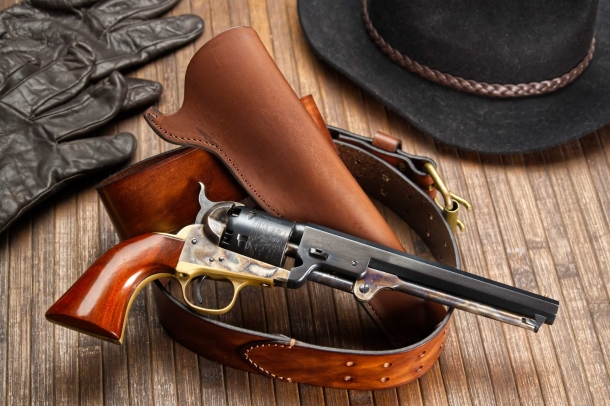
Uberti replica of the Colt 1851 Navy revolver, a belt revolver, with a smaller size and weight compared to the previous Walker and Dragoon military models.
Finally, there's one last, more incidental reason, an industrial one, that comes down to plain production convenience: back then (and often still today), tools weren't sized in decimals, but in fractions of an inch.
A revolver of nominal .36 caliber had its cylinder reamed, as we said, to .375 (remember that nominal caliber was measured across the lands). As luck would have it, that's exactly 3/8 of an inch… a handy tool that was easy to come by at the time.
If you had to build a revolver small enough to carry comfortably on your belt, that was the tool that let you cut 6 chambers into a cylinder sized for the job.
The Walker had its barrel bored to .44 before rifling, and .44 is almost exactly 7/16" (.4375"). That left a small margin for the final polishing of the bore before it was rifled.
The same goes for the first .31 caliber revolvers: here too the size was that of the tool used to bore the barrel, basically 5/16", or .3125". That left a small margin for final polishing up to the .315" bore (across the lands), the actual caliber of the nominal .31, before rifling.
The question of where caliber names come from is a tangled, complex one, and poorly documented for that era. But all of these considerations at least offer a reasonable explanation of why such apparently unseemly numbers as .28, .36 and .44 were picked for the early Colt revolvers. Thanks to their huge commercial success and, let's be honest, the traditionalism the gun market has always been known for, those numbers then stayed unchanged on later models and were adopted by many other makers. In turn, they gave rise to several metallic cartridge calibers, such as the .38 Special, the .357 Magnum and the .45 Colt.
Incidentally, the same rules on nominal caliber versus the actual diameter of the balls to use still apply to modern cap-and-ball revolver replicas, like the Uberti ones pictured here, which load exactly the same way.