




Chiappa Firearms 1911 pistols: test and review
1911 pistols Made in Italy? Yes, and good ones, by Chiappa Firearms. We got our hands on them and saw how they are made (and shoot)

Chiappa Firearms is a well-known name in Italian firearms manufacturing, with a wide and diverse line of guns, ranging from fun and affordable, like the Little Badger and other .22 Long Rifle plinkers, to muzzleloading replicas, to excellent lever actions, both in classical and modern versions, to the futuristic and unique Rhino, now available also in .44 Magnum.
Once prerogative of US firearms manufacturers, the 1911 pistol platform has gradually spread worldwide, starting from the Chinese, then the Philippines, now the Turks. So, given that a non-US made 1911 is no longer blasphemy, why not an Italian 1911?
The Chiappa Firearms 1911 pistols are available chambered for both the 9 Luger and .45 ACP . And rest assured, Chiappa 1911s are Made in Italy.
Chiappa made some huge investments in their 1911-line production, buying new CNC machines for the specific purpose, and investing a lot of time and research into the cast steel frame (more on this later).
All gun parts are machined in-house, apart from the initial stages of processing of the steel frames and few details of the barrels, done by carefully selected third parties in nearby Gardone Val Trompia, and then finished and assembled in Italy by skilled personnel.

Chiappa Firearms 1911 "Field"

Chiappa Firearms 1911 "Field"
THE FRAME

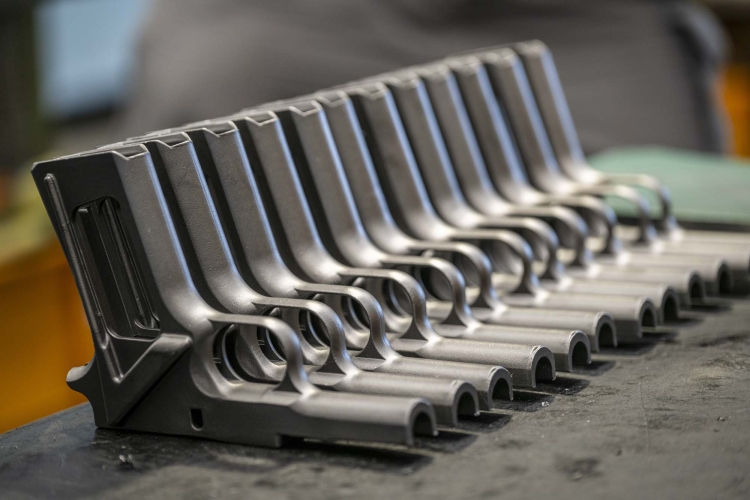
Chiappa preferred to start with a cast steel frame, to keep production costs down and consequently achieve a competitive final price, without compromising the quality, reliability and durability of the weapon.
This was not as easy as one can think at first glance... indeed, it was a very, very difficult process, since the frame of the 1911 was not designed from the start to be manufactured by casting, but by milling, and getting some sections right by casting is a daunting task: indeed, it is the very reason behind the bad reputation that follows cast frame 1911 models: just switching to investment casting is not enough, not even close, as you'll get bad tolerances, warped sections, cracks and a lot of other headahces and quality issues, as several manufacturers learned at their own expense.
That didn't stop Chiappa's engineers from trying... and succeeding where many others had failed.
This is also the reason why the steel casting process is the only part outsourced to a carefully selected third party with in-depth know-how of this method, that worked in close collaboration with Chiappa engineers and technicians who re-engineered the frame from scratch to optimize the end result. A lot of effort, trials and errors, and some clever engineering peculiarities devised by Chiappa, went into making sure the cast parts keep strict tolerances with minimum machining requirements.
I can’t delve more in depth on this subject, as many details are necessarily confidential, but let me say that, as someone who has studied metallurgy for many years and has a good understanding of steel working, I was impressed at the cleverness and difficulty of achieving some of the result Chiappa engineers have been able to implement in their 1911 frames. There is so much more than just injecting molten steel into a die to making a good cast steel frame, details that are not visible to the end user, but that are very important to the process, to get an excellent end result.
The real point is not which process is used, but how it is implemented in terms of alloy choice, manufacturing process, heat treatments, finishing etc. With the use of the right alloys and processes, cast steel frames are as solid as forged ones, but allow significant price tag savings for the end customer. The rough frame blanks are then milled and finished in Azzano Mella on CNC machines, subjected to quality checks and tolerance verifications, and then sent to finish and assembly.

THE SLIDE

The slides are machined out of extruded and surface ground bars, milled on CNC machines in a process carefully devised to minimize the number of times the part has to be moved from a support to another, for best tolerances.
Chiappa invested a lot in this new manufacturing process, buying new CNC machines to insure the best qualitative levels while keeping a consistent product output flow. This care in quality of the finished product is easily seen in the neatness and crispness of all planes and angles in the slide.
Specifically, surface grinding is done as a first step, to insure excellent consistency in the slide's thickness, which turns into very low tolerances as the blanks are mounted in the horizontal CNC mills. The choice of a horizontal CNC mill is in turn the result of careful planning as well: while more specialized than the 5 axis CNCs that seems to be all the rage in modern manufacturing (Chiappa Firearms has those as well, but they are used for other purposes), it allows better tolerances at a lower price point and a faster set up for small batch production.
All these details, that can seem technical quirks to the inexperienced observer, are critical production engineering features that allow faster and less expensive production, without sacrificing quality (indeed, it turns out it improves quality as well).



THE BARREL

Bored and rifled barrels blanks are acurately machined to shape in the Azzano Mella factory.
The barrel is the classic 1911 barrel, again carefully machined to ensure proper tolerances, particularly when it comes to the locking half moons and the shoulders where the slide release pin rests.
It is all too common for manufacturers to sacrifice long term durability for the sake of an action that appears snug as a safe door, while actually all the parts slam together leading to premature wear and metal fatigue.
In this case, all details are machined so that tight tolerances are achieved without sacrificing that tiny, tiny slack the system needs to work accurately without crunching itself to premature failure.
Another critical aspect is the position of the traditional (no feed ramp) barrel throat in relation to the frame-milled feed ramp. Again, everything is as it should be, with tight tolerances, but not so tight to indicate that durability has been sacrificed to snug fitting.
Back then this could only be achieved by painstaking manual adjustment of all the parts, until the necessary fitting could be obtained.
The usual compromise was between a more affordable, but necessary loose standard military/civilian fitting, that sacrificed accuracy to reliability and durability, and the extreme tailor-fitting mechanims of custom guns, that sacrificed (or, more usually, totally forfeited) affordability in favor of optimal accuracy and good durability and reliability. As they said, you could have your 1911 affordable, accurate and reliable, but you could only choose two.
Modern CNC machining has changed the equation and today you can "cheat" and have guns that have all three features. Neat.
Manual fitting still has a place, though, as we'll see in a moment.


ASSEMBLY

At Chiappa the assembly process of the 1911 pistols is divided into two different lines, one for the Field and Superior Grade models, one for the Empire Grade models.
The Chiappa 1911 Field and Superior Grade models are assembled by skilled workers with a deep knowledge of the 1911 anatomy and feed cycle, granting that everything works properly, yet keeping the end price as affordable as possible.
Empire grade 1911 models instead are not just “assembled”, but undergo an accuracy and smoothness enhancing process by expert gunsmiths, involving careful hand fitting of the gun parts.
The price of the Empire Grade models is clearly going to be higher but, thanks to the smart production engineering of the manufacturing process, that yields parts much closer to the finished quotes, it’s still more affordable than most other 1911 similar quality products on the market.


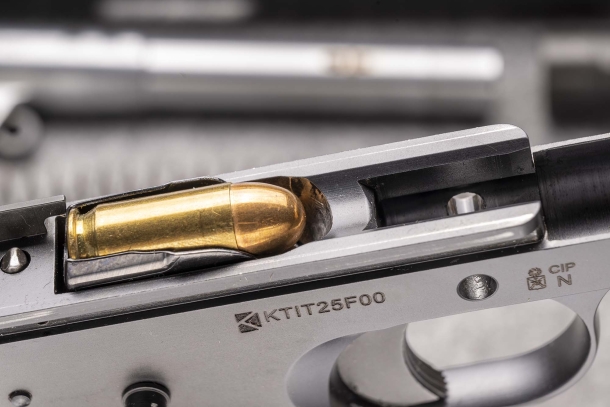

Back in time, assemblying a 1911 required extensive manual labor, and the best way to minimize this was to have very lax tolerances.
Today this is no longer necessary, thanks to CNC machining that can produce components very close to final tolerances, so close indeed that tolerances of the components for even the Field models, as they come to the assembly line, require a good degree of slackening.
All 1911 lines are assembled by Kitam, Chiappa's brand dedicated to the 1911 pistols line, within a facility in Azzano Mella, in the same plant where Chiappa Firearms is headquartered.
The clever part of having the Field, Superior and Empire grade versions assembled in the same facility and, indeed, in the same large space in the factory, is that there is a constant know-how osmosis between assembly line workers and skilled gunsmiths, and that a skilled gunsmith can be called upon if an issue ensues on the more affordable line of products.


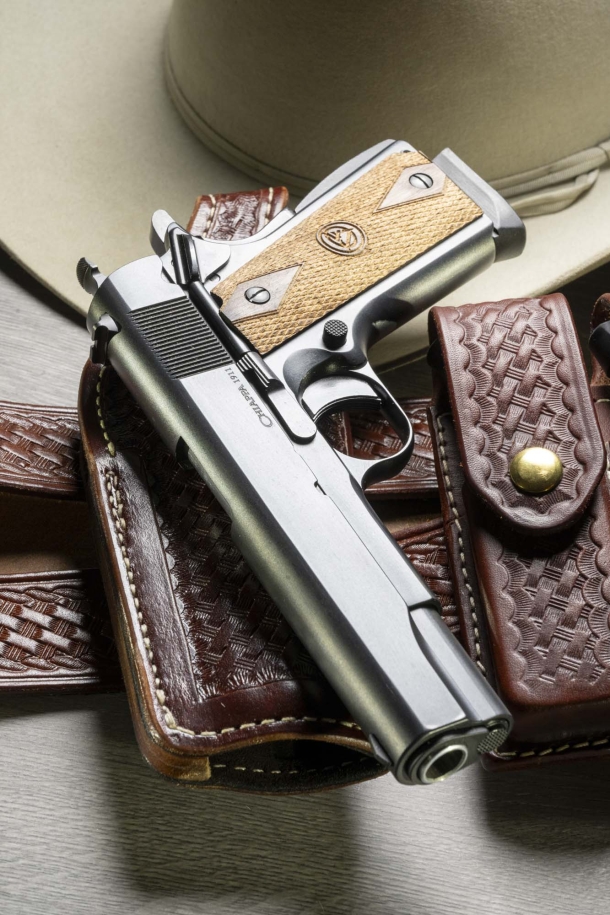
The Chiappa 1911 "Field" version features the classic M1911A1 Government design
FIRST HANDLING IMPRESSIONS

The Field Grade 1911 looks like most “GI” 1911s, with just a lowered ejection port to enhance reliability. Tolerances are tight for a production, “military” 1911 but not so tight as to be cause of concern. The overall esternal finish of the Chiappa 1911 Field Grade pistols looks very good, as well as the general mechanical fit, with the slide working smoothly on the frame.
Racking the slide gives a feedback of solid precision. The barrel muzzle and chamber hood have that minimal play that shows the locking lugs and barrel link fit the right way: not loose, not jammed hard in the slide’s recesses to the point of causing premature wear.
The trigger of the Field Grade 1911 models is a factory 1911 trigger, but it is very good for a factory 1911 trigger: it's short and crisp and clean, with an average trigger pull of about 3 lbs (1.4 kg) it's just heavy enough to be safe for self defense use.
The manual safety snicks positively on and off, while the grip safety activates well, but requires a firm grip of the hand on the grip itself.
The Superior Grade is right there, but with better, wider finish options (such as the beautiful full case-hardened model).
As it comes to the Chiappa Empire lines models, even a quick check easily shows the differences from the others. The first and more significant impression you get is the mechanical feeling you have handling them: they offer an excellent trigger, match tolerances, a softer manual and grip safety activation and a very smooth and consistent cycling. In addition to this, the Empire Grade models also showcase differences in terms of external finish.

The Chiappa 1911 "Field" version features the traditional M1911A1 Government design

Except for the basic Field model, all Chiappa 1911 are Optics Ready
SHOOTING THE CHIAPPA 1911 PISTOLS

I tried both the Field and Empire, and while the Field is a very good 1911, the difference between the former and the Empire models is there: it’s not just a matter of accuracy, which is very good in both cases, but in how the Empire models cycle in a more consistent, smooth way, allowing the shooter to immediately find a cadence.
Indeed, I had almost no doubt that the top tier versions would distinguish themselves, so what I really wanted to test was the reliability of the base model, the 1911 Field Grade.
Therefore, I put it through the wringer by firing several dozens of magazines of Fiocchi 230 grns FMJ and Sellier and Bellot 230 grains FMJ ammunition in slow, deliberate fire, in magazine dumps fired as fast as I could, then by deliberately limp-wristing the gun to the extreme while shooting both slowly and fast sequences, and then by firing it sideways and upside down.
The Chiappa 1911 Field Grade went through the whole ordeal without a hiccup: it’s one of the best G.I. style 1911s I ever had the pleasure to shoot. All quotes are standard, so you can use all accessories that fit a mil-spec 1911. The same is true for the Superior and Empire versions, where Chiappa also offers models with Optics Ready slides milled for the use of a MRDS.
The best group was obtained (unsurprisingly) with an Empire model at 20 meters, with 4 holes almost touching and a fifth less than an inch left and low. The Field Grade yielded tight groups about 3" wide at the same distance and it was easy to keep all shots in a paper plate at 10 meters in rapid fire.

And if you like 9mm on a 1911, you have it
CONCLUSIONS

The immortal 1911, Made in Italy
I have seen, touched, disassembled and fired a lot of 1911s, enough to be able to understand where to look for differences and defects.
In a market overpopulated with 1911 models of all types, finishes, quality levels and prices, it is very difficult to attract someone's attention and convince people that a product is a good product.
Well, yes, it's comparatively easy with exclusive, collectible 1911s, as we often see these days, but with a honest, well-made production 1911 pistol, one of the greatest and most timeless classics of all time, not so much. Chiappa Firearms' 1911s definitely got my attention.
So, if you want an accurate, reliable, well finished and well priced 1911 which is also Made in Italy, whatever tier of gun you choose among Field, Superior or Empire grades, a Chiappa 1911 will give you quality well above its price tag.


