



Investarm Great Plains Rifle
Made in Italy fifty years ago, the Investarm Great Plains Rifle has been the first modern replica in the style of the legendary Hawken rifles, the heavy-barreled hunting muzzleloaders which played a fundamental role in the years of conquest of the American frontier.
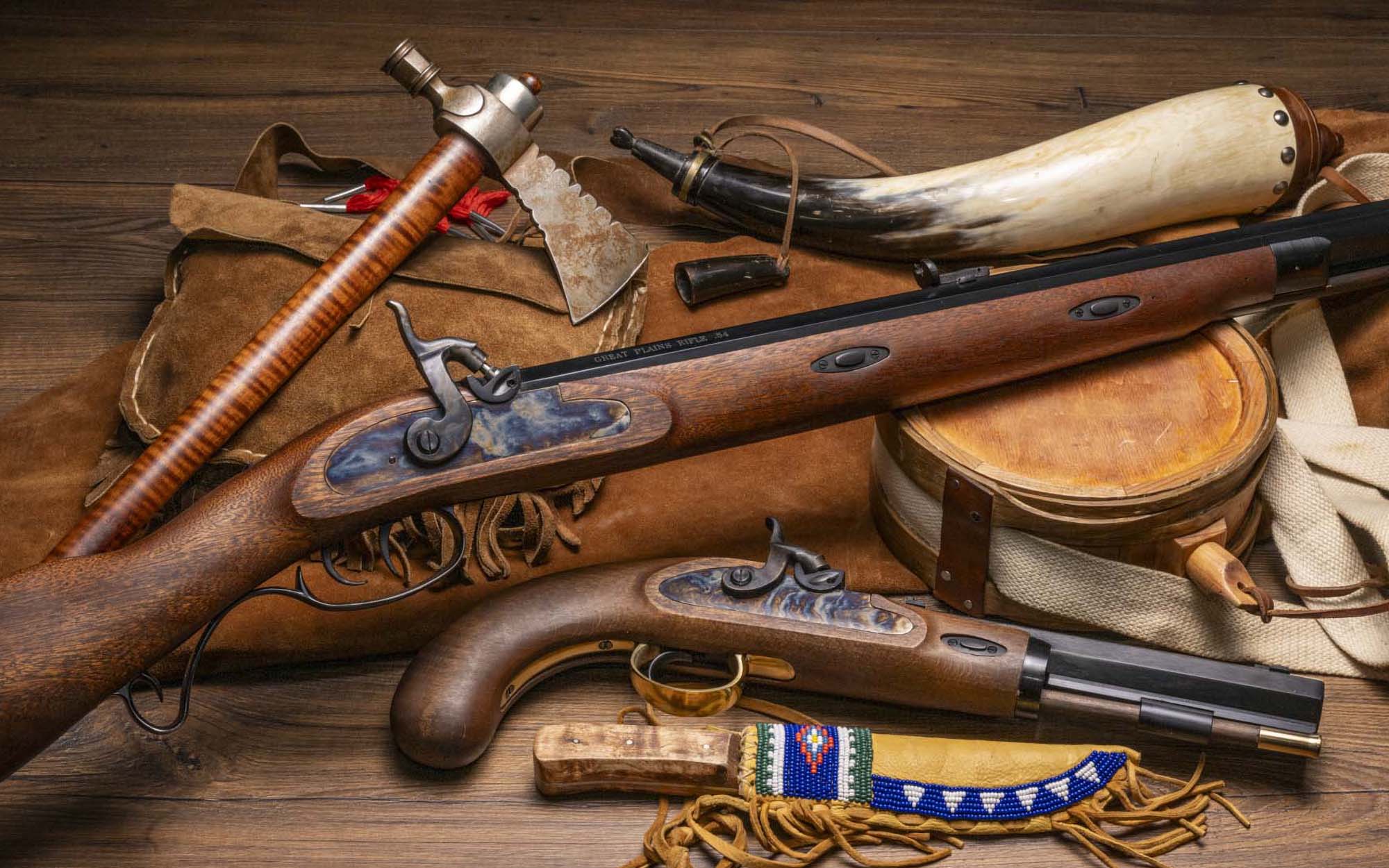
Investarm Great Plains Rifle
The transition from the lush forests of the East to the vast, unforgiving expanses of the American West demanded a fundamental change in firearm technology. The Investarm Great Plains Rifle serves as a modern bridge to that era, meticulously recreating the tools that allowed frontiersmen to survive the "Big Sky" country.
The Need for Power
During the years 1800–1850, as explorers and settlers pushed past the Appalachian Mountains, they encountered an environment vastly different from the eastern woodlands. The legendary Pennsylvania and Kentucky rifles, while elegant and accurate, were designed for smaller game like whitetail deer and turkeys.
As Lewis and Clark noted during their 1804–1806 expedition, these small-bore rifles lacked the "stopping power" required for the massive fauna of the West. On the Great Plains and in the Rockies, hunters faced bison, elk, and the formidable grizzly bear—animals that could easily survive a wound from a light .36 or .45 caliber round ball.

The Hawken rifles: conquerors of the West
To meet this challenge, Jacob and Samuel Hawken of St. Louis developed what would become the quintessential "Mountain Man" gun. The Hawken rifle was a rugged, shortened, large-bore tool built for survival. Unlike the fragile, long-barreled eastern rifles, the Hawken featured a heavy barrel and a sturdy stock.
These rifles were typically chambered in .50 or .54 caliber, and sometimes as large as .62. This increased mass allowed frontiersmen to reliably hunt 1,000-pound bison and stop a charging grizzly. It was the "magnum" of its day, essential for any "free trapper" heading into the high country.
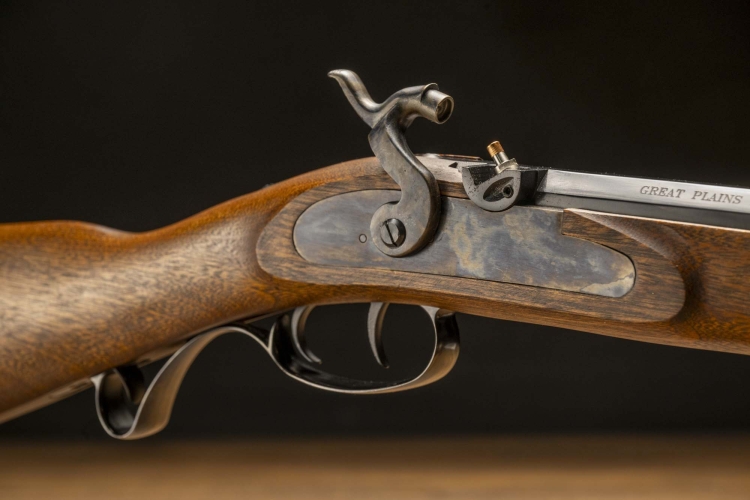
The ignition system is with percussion caps

The rifle can mount Buckhorn or Half Buckhorn rear sight
A true plains rifle is defined by its utilitarian beauty. Unlike the full-stock rifles of the East, these usually featured a half-stock design, which reduced weight and prevented the wood from warping or cracking in the dry mountain air.
- Barrel: Heavy, octagonal, and typically 30 to 34 inches long. The thickness helped stabilize the rifle for long shots and absorbed the recoil of heavy powder charges.
- Calibers and Projectiles: The .50 and .54 calibers were most popular. While they primarily fired patched round balls, modern versions often utilize conical bullets (like the Maxi-Ball) for increased sectional density.
- Stock and Hardware: Stocks were crafted from walnut or maple, often featuring a "buckhorn" rear sight and a crescent-butt plate.
- Triggers: Most were equipped with double-set triggers; pulling the rear trigger "set" the front one to a hair-thin break, allowing for extreme precision.

Left side view of the stock, with the cheek piece
The Investarm Great Plains Rifle

The Investarm Great Plains Rifle has been a staple for black powder enthusiasts since the early seventies, when it was first presented to the US market under the Lyman brand (the successful Lyman Great Plains Rifle). In terms of “details”, its design has never been 100% faithful to the original Hawken design, but its whole aspect fits the role and captures the rugged spirit of the 1830s with modern manufacturing consistency.
The rifle features a classic half-stock style, crafted from select European walnut with a rich, dark finish that complements the historically inspired "browned" hardware. Its barrel is a massive 32-inch octagonal piece with a slow 1:60 twist, specifically optimized for the traditional patched round ball.
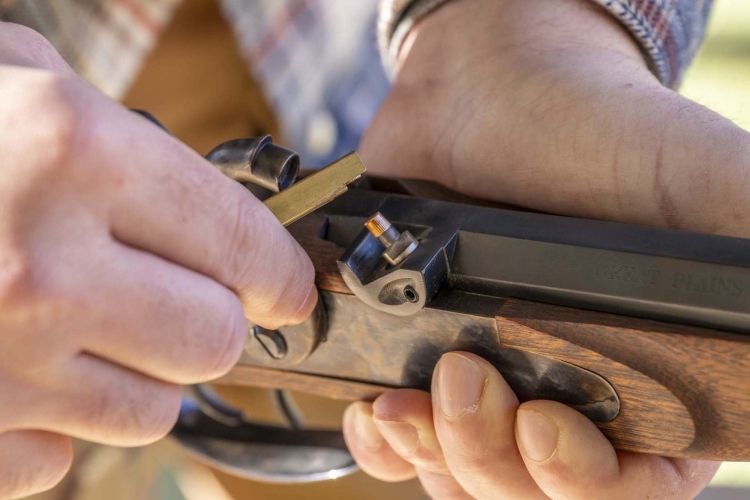
The lock is a traditional side-lock percussion system, featuring beautiful color-case hardening and a strong spring that ensures reliable ignition. It utilizes a hooked breech system, allowing the shooter to easily remove the barrel for cleaning—a vital feature for black powder firearms.
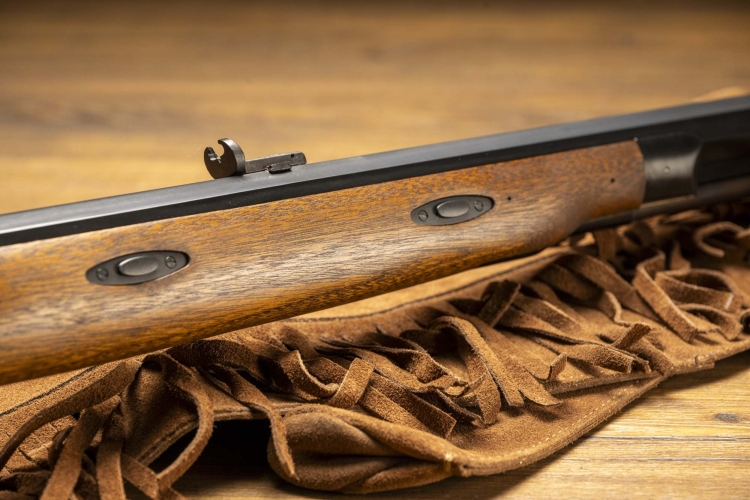
The two metal wedges that secure the barrel to the stock

The barrel is secured to the stock via a rear tenon
Caliber Comparison: .50 vs. .54
The Investarm Great Plains Rifle offers a robust platform for those who value the "one-shot" philosophy of the 19th-century frontier. For over fifty years this rifle has been offered in the two classic calibers, for this kind of muzzle loading, black powder rifle: .50 and .54, round ball or conical.
Choosing between these two classic calibers depends on your intended use.
The .50 caliber is a quite popular choice for modern muzzleloading rifles, with slightly flatter trajectory at moderate ranges of 50-100 meters, making it an excellent choice for target shooting and mid-sized game like whitetail deer.
The .54 caliber, however, is the more "historically accurate" choice for a Great Plains rifle, that was intended to hunt big animals at distances often over 100 meters. It delivers significantly more kinetic energy upon impact. While the lead ball is heavier and drops more quickly at long distances, it provides the terminal performance necessary for elk or moose.
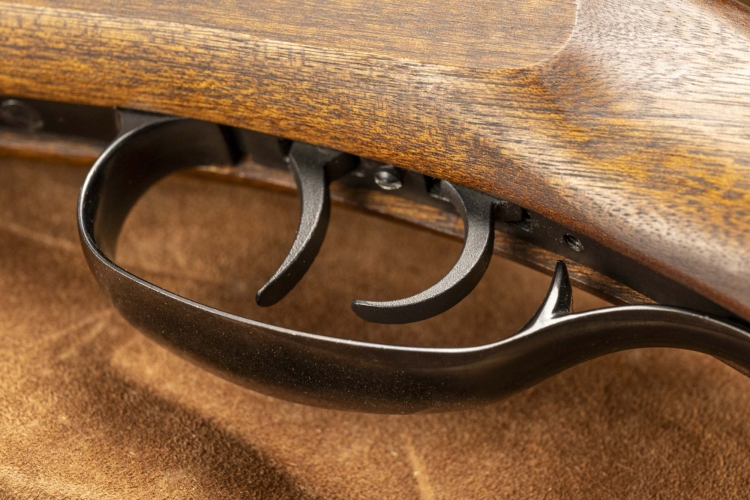
The double set trigger

Pulling the rear trigger activates the mechanism that lightens the pull of the front trigger
The Double-Set Trigger System
A standout feature of the Investarm model is its mechanical trigger assembly. It operates in two modes:
- Standard: You can pull the front trigger alone for a typical, heavier hunting weight.
- Set: By pulling the rear trigger first (you will hear a distinct "click"), the front trigger is "set." This reduces the required pressure to a few ounces, allowing the marksman to fire without flinching or pulling the rifle off-target.


Why the Coil Spring?

If you were to remove the lock plate from your Great Plains Rifle, you would see a horizontal housing that contains the mainspring and a plunger. When you cock the hammer, the tumbler (the internal rotating part connected to the hammer) pushes against this plunger, compressing the coil spring.
The Investarm Great Plains Rifle is somewhat unique in the world of modern reproductions because its percussion lock utilizes a coil spring (often paired with a plunger) for the mainspring, rather than the traditional leaf or V-spring found in 19th-century originals.
While a traditional "V-spring" or leaf spring is more historically accurate—and indeed, many high-end custom Hawkens still use them—Investarm opted for a heavy-duty coil spring for several practical reasons:
- Durability: Coil springs are notoriously difficult to break. In the black powder world, a snapped leaf spring can end a hunt or a competition instantly. Coil springs maintain their tension over thousands of cycles with very little risk of fatigue.
- Consistency: The linear compression of a coil spring provides a very consistent hammer fall, which is critical for the reliable ignition of percussion caps.
- Ease of Replacement: If a coil spring ever does need service, they are standardized and generally easier for the average user to replace without the specialized "spring vice" tools often required for high-tension V-springs.
Investarm Great Plains Rifle
The loading of a muzzle loading black powder rifle is a methodical process that requires attention to safety:
- Clear the Breech: Fire a percussion cap to ensure the nipple and flash channel are dry and clear of oil.
- Measure the Powder: Never pour directly from a flask. Use a graduated measure to pour a specific volume of black powder (e.g., 80 grains) down the muzzle.
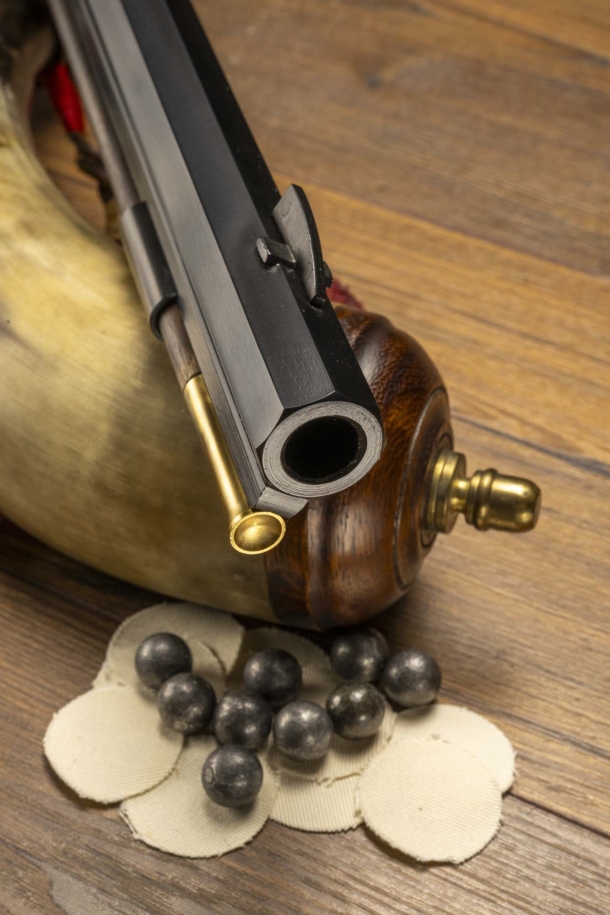
- Patch and Ball: Place a lubricated cloth patch over the muzzle, center a lead round ball on top, and use a short starter to push it into the bore.
- Seat the Load: Use the ramrod to push the ball down until it is firmly seated against the powder. A gap between the ball and powder can cause the barrel to burst.
- Prime: Place a copper percussion cap on the nipple. The rifle is now ready to fire.

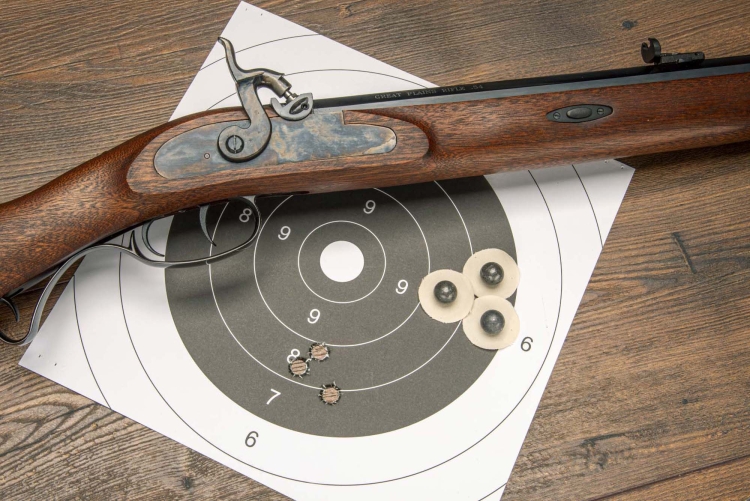
A 1.6-inch, 3 shots group taken at about 60 meters
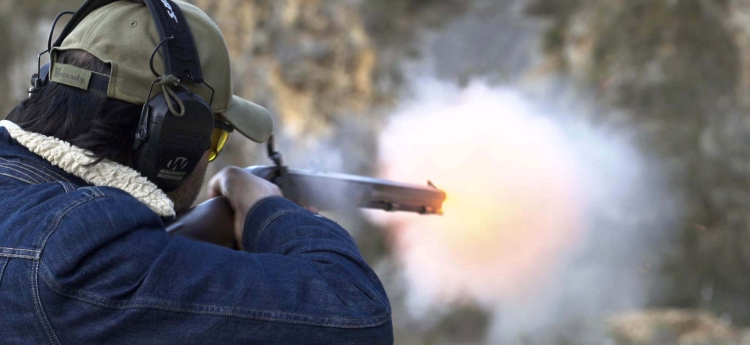
A good modern Hawken-style muzzleloader, like those produced by Investarm, can be surprisingly precise. When using a patched round ball and the correct black powder charge, a shooter can expect to achieve 2 to 3-inch groups at 100 yards. Because of the slow twist rate in the rifling (often 1:60), these rifles stabilize the round ball perfectly, making a .54 caliber ball an effective hunting tools out to 125 or 150 yards in skilled hands.
We have tested the Great Plains Rifle at a distance of about 60 meters, loaded with a .530” round ball, a 0.10” thick patch lubed with Ox-Yoke liquid Wonder Lube, over a 70 gr of FFG black powder.
We have shot from a rest, looking for accuracy, but without “thinking too much”, as we wanted to verify the realistic average behaviors of the rifle, in a way repeatable by anyone, possibly. In 4 series of 3 shots each, the average group size has always been under two inches, with the best one of just 1.6”. quite good, if we consider that with this rifle you have to sight using a quite large half-buckhorn hunting sight.
Our conclusion is a very practical one: the Investarm Great Plains remains the go-to choice for those who want to experience the American frontier without a custom-shop price tag. The rifle may not be a truly faithful copy of a Hawken rifle in every minor details, but it's honest, and works.

