

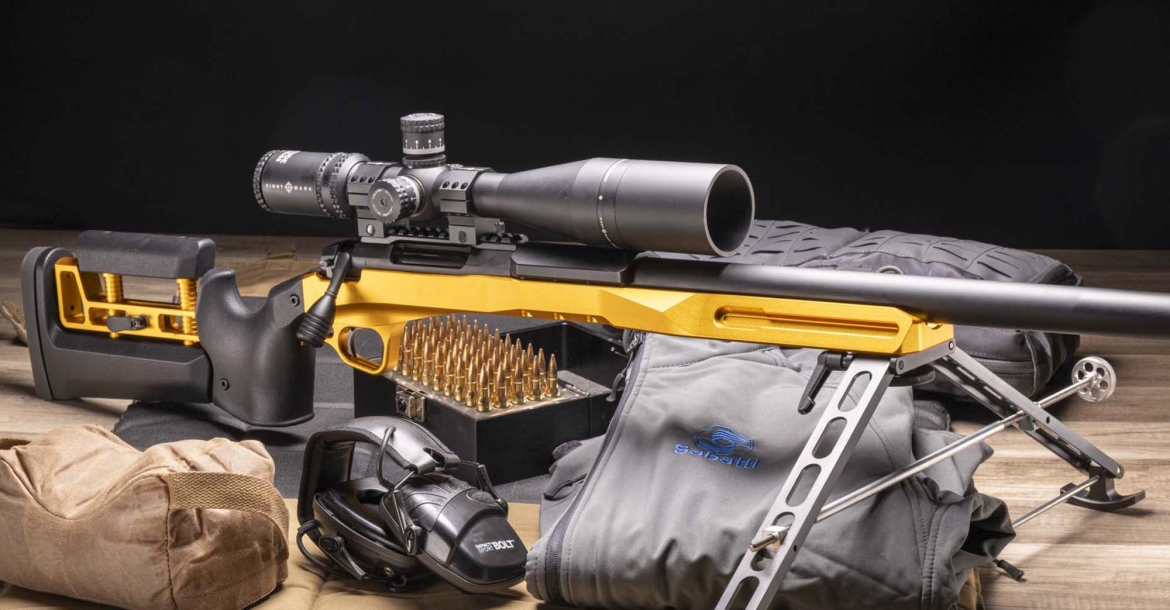


Sabatti Oblivion: First contact
We had an exclusive first look at the brand-new Sabatti Oblivion rifle for long-range precision shooting, and it's truly exceptional.

In a world of firearms that claim "new developments" almost daily, often limited to a new stock or a unique color scheme, it is rare to get a truly innovative and extraordinary rifle like the Sabatti Oblivion, featuring truly new characteristics protected by international patents.
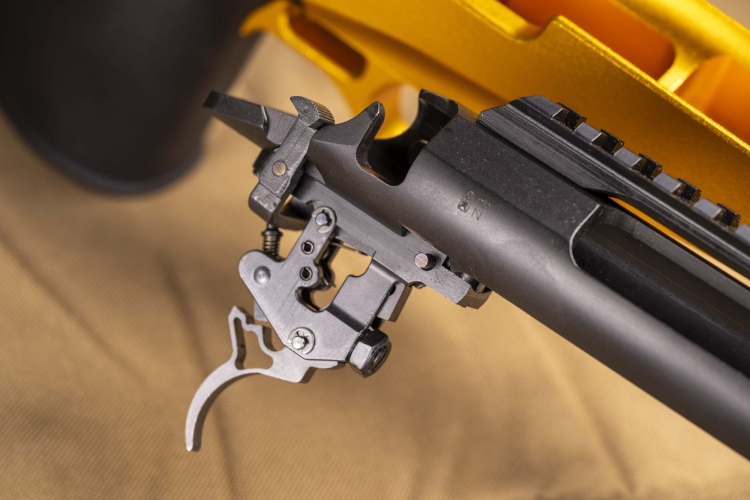
Let's start with the action, even if it's not the most innovative part: this is the tried-and-tested Blizzard, already seen on several other models, but here featuring a closed-receiver single-shot action for greater rigidity, fed through the ejection port, and a screw-on, replaceable Picatinny rail.
Nothing new, you might say; in fact, it's fairly standard for rifles in this category.
True.
However, this version integrates well with the true innovation of this model, which we'll see in a moment.
First, let's have a look at the bolt: it's a further improvement on the Blizzard bolt, in this case featuring a separate head made of special steel and subjected to specific heat treatments different from those of the body.
The extractor is still the very solid and reliable Blizzard guillotine extractor, combined with a piston-type ejector.
The bolt body is also subjected to a special different heat treatment to ensure a high surface hardness, improving smoothness while also ensuring solidity and robustness.
The trigger is the highly regarded Sabatti Match three-lever design with a two-position safety, featuring a clean and crisp trigger break, with a short overtravel at constant weight, without any sign of collapse, designed to avoid disturbing the rifle’s aim at the most critical moment.
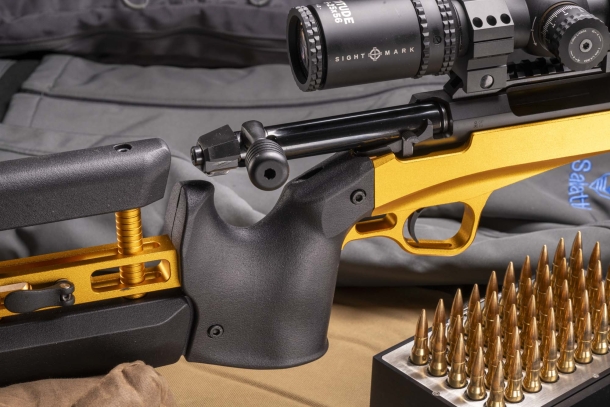


Sabatti Oblivion Black
The rifle is available with two different barrel versions:
- Oblivion F-Class Open: 760 mm / 30” cylindrical barrel with 31,75 mm / 1.25” muzzle diameter
- Oblivion F-Class TR: 760 mm / 30” tapered barrel, with 28 mm / 1.10” muzzle diameter

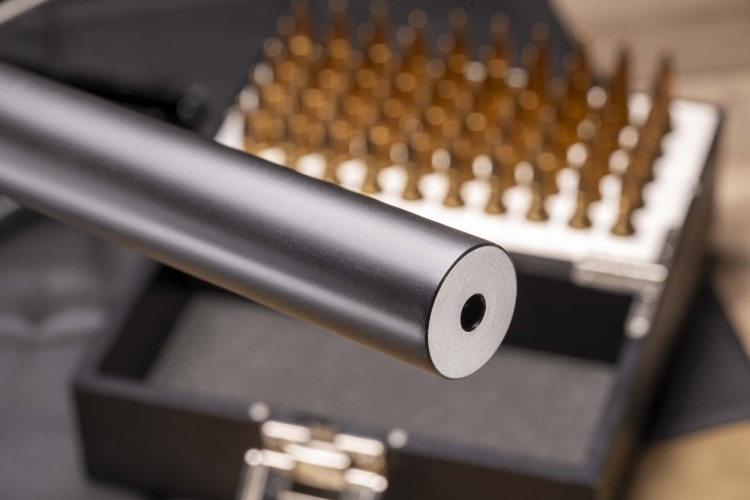
The barrel is another peculiarity: instead of adopting the MRR rifling for which Sabatti barrels are famous, an apparently counter-trend choice was made, adopting traditional rifling.
I say “apparently”, because in reality Sabatti’s goal is always to offer barrels capable of the highest precision, and the Oblivion’s barrel is made with an innovative electrochemical machining system (not to be confused with electrical discharge machining, which is a different thing).
Electrochemical machining is a non-contact machining system that allows for a rifling characterized by extremely low roughness compared to any other process, and extremely sharp corners, both positive and negative, on both the leading and trailing edges, something not achieved even with single-cut rifling. Furthermore, unlike mechanical rifling processes, it does not induce the least mechanical stress in the barrel, ensuring significantly improved thermal stability.

Sabatti Oblivion Gold
It is precisely at the thermal level that the most innovative feature of the Oblivion comes into play, the one covered by specific patents: the chassis.
The action is coupled to an Anticorodal aluminum alloy chassis using a Barrel Block system with an eight-screw sleeve that allows both the barrel and action to be fully free-floated (the screw visible on the bottom of the action is one of the two screws that secure the stock to the chassis, and does not involve the action in any way).

This system eliminates the need for any type of bedding and eliminates any tension introduced by traditional action screws, although the action still features traditional threaded holes for compatibility with other Sabatti stocks.
The Barrel Block system and the closed action ensure remarkable rigidity to the entire system. The chassis and action are coupled at the chamber and forcing cone section of the barrel, where the heat produced by firing results in the greatest increase in temperature. Anticorodal, rather than Ergal, the more commonly used material for chassis, was chosen because it has better thermal conductivity.
The entire chassis, (this is the patented feature), acts as a heat sink, thanks also to the machining at the forend, which features large radiating surfaces at the bottom, and the coupling with the stock, which also contributes to heat dissipation, with the parts in contact with the shooter protected by polymer to ensure thermal insulation.


This system offers several advantages. First of all, a fluted barrel is not necessary to dissipate heat: fluting is a solution that, as precision shooters know, still introduces irregularities and stresses that result in a drop in accuracy, and is still insufficient to effectively dissipate the heat generated by long shooting sessions.


The Barrel Block sleeve that surrounds the Oblivion's barrel provides highly effective heat transfer from the barrel to the chassis, and excellent heat dissipation: the aluminum alloy has a thermal conductivity far superior to that of steel, which is a poor heat conductor. This results in heat being transferred to the chassis, which has a significantly higher thermal capacity, combined with the aforementioned large radiating surfaces.


A 0,13 MOA five-shot group at 300 meters (333 yards) by competition shooter Daniele Zanelli with the Sabatti Oblivion.
The end result is that the barrel and chassis reach thermal equilibrium very quickly, the heat generated by firing is dissipated by the chassis and, even during very long shooting sessions, the barrel remains at a temperature that is safe to touch with bare hands.
In addition to actively contributing to heat dissipation, the stock features a cheekpiece adjustment system, while its length can be adjusted with additional shims. The handguard design is typical of F-Class rifles: beavertail-style and with an integral Arca-Swiss rail for competition bipods.
The chassis is anodized in bright orange or blue, with a black polymer grip and cheekpiece.
The rifle weighs 7,2 kg (15.9 lbs) for the F-Class Open version, and 6,8 kg (15 lbs) for the F-Class TR version. The Oblivion is currently chambered only in .308 Winchester, although at least one 6.5 chambering will be made available within the end of 2026.
